(Today's post is a guest post from Alexa at Culture Porn. As members of the Feminist Fashion Bloggers, Alexa and I are swapping posts today, both looking at the role of men in feminism. You can find my post on Alexa's blog.)
Hello, my name is Alexa and I write a blog called Culture Porn, which can be found here.
I think it's safe to say that there is one fundamental misconception about feminism. The irritating thing is, this misconception is embedded within the name: feminism. As if the term, and everything that goes with it, can only be applied to the female gender. Now, I am of the belief that the feminist movement will always remain a movement - a group with ideas and opinions contrary to the popular grain - without a male edge. This earth has a lot of males in it, and for people to think that feminism is an exclusively female preoccupation is hindering its ideas and indeed, support.
A lot of feminists neglect the fact that males are perfectly capable of being feminists too. After all, the idea of gender equality cannot be applied to only one gender. And indeed, of the males I asked, every single one of them shunned the idea of feminism. It was only after I rephrased the question; "do you believe in gender equality?" (as opposed to "are you a feminist?") did I get a response. The power of a name eh?
So I suppose, the issue facing feminism right now is how to remove this misconception. Is it just all about a name, or are there other factors at play as to why males tend to refute the fem in feminism? I'm sure there are some men out there who actively reject gender equality due to a number of draconian concepts; a cling to tradition, dominance, social spheres, religion, cultural expectations, taboos. But i'm equally sure that they are a minority. I keep my confidence in the modern, educated male who appreciates the immense value and humanity behind gender equality, even if the name feminism is decidedly 'girly'. Although a revamp of the English dictionary would go a way in helping this, I think trust must be placed in curiosity; that the modern, educated man I previously spoke of will do his research before casting off the title of a feminist.
On a side note, I just want to say that I do not consider women who dislike men as feminists. Equality swings both ways, after all.
(If you like this, go check out Alexa's great blog full of art, feminism and fashion. And check out the other FFB posts in today's roundup!)
Showing posts with label feminism. Show all posts
Showing posts with label feminism. Show all posts
Wednesday, May 11, 2011

Wednesday, April 13, 2011
FFB: Finance and the Fashion Blogger
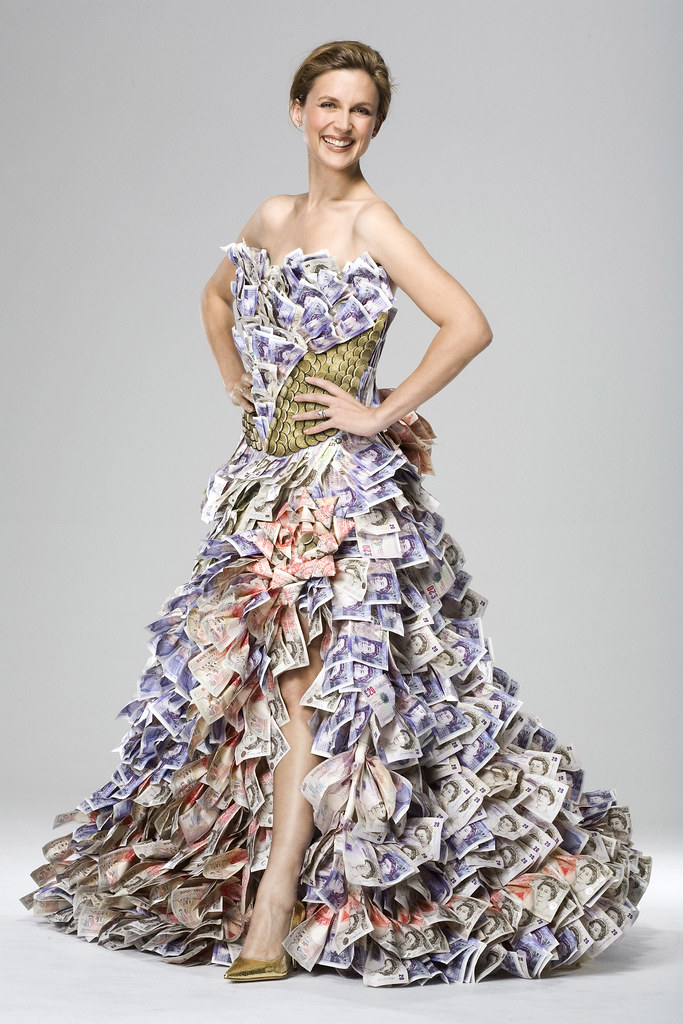
Image from peoples50million
The Feminist Fashion Bloggers have now shifted to monthly posts... this month's topic is "Finance, Feminism and the Fashion Blogger," in honor of yesterday, April 12, being Equal Pay Day. This day symbolizes how far women would have to work into 2011 to earn the amount of money that men made in 2010. Clearly, money - earning money and spending money - can be a feminist topic. But how does it relate to fashion? I wanted to look at this topic by focusing on the often-gendered value judgements that are made about shopping and consumption: specifically, the fact that buying/consuming items coded as female is often seen as more negative/unnecessary than buying items coded as male or unisex. I've been thinking a lot recently about why there is still something of a stigma associated with owning a lot of clothes or shoes or beauty products, much more so than for owning, say, many video games or tech gadgets or DVDs.
For an example, let's take shoes. Stereotypically (and I know this is not true of all women!), women love buying shoes, own many pairs of shoes, see tiny differences between pairs of shoes, and spend money "frivolously" on additional unnecessary shoes. Women "waste" money on expensive, fancy, uncomfortable shoes.

So why is there a perceived difference (practically a moral difference!) between a woman who buys a lot of shoes and a man who buys a lot of tech products? Or a woman who buys a lot of tech products? An argument can be made that the difference between shoes/fashion items/beauty products versus other items of consumption is in their inherent utility or lack thereof (in fact, I've had this discussion with my boyfriend). Getting a new computer, or iPhone, or the other latest tech device provides you with additional utility. It's faster, lighter, more powerful than your old devices. It provides you with functionality that you did not have before. If I already have a pair of shoes that are in good shape and comfortable, I'm probably not buying a new pair of shoes because those shoes are in better condition, allow me to walk faster, or are more comfortable than the old shoes. Perhaps they can be worn with different outfits, or are appropriate for different occasions. But more likely, my new pair of shoes is primarily useful for aesthetic reasons... they may not fill a particular need besides my desire to wear beautiful and satisfying shoes.
But why do we argue that purchasing for aesthetic reasons is less justifiable than purchasing for other kinds of needs? What's wrong with buying shoes just because they're beautiful? I suspect that part of this is because a focus on aesthetics, particularly the aesthetics of the body, is placed strongly in the domain of the female. And as a female-coded focus, it is given less weight than a "male" focus on utility or speed or power.
As an artist, I believe that aesthetics are incredibly valuable, including the aesthetics of self-presentation. Consequently, I'm lucky enough to have an overflowing closet and more clothing than I know what to do with. The great majority of what I wear has been thrifted at the dollar-a-pound...so my overall cost for this full closet is actually quite low (generally less than a dollar per shirt, skirt, or dress...perhaps a dollar or two per pair of shoes...maybe four or five dollars for a coat or pair of boots or other particularly heavy item.) But I'm aware that it may look like I spend a lot of money on clothing and shoes. And I feel like this is supposed to be bad. I'm careful to mention on occasion how much of my outfit is thrifted, lest people see me as irresponsible with money, buying all those fashion-related things. Have any of the rest of you experienced this? As a feminist, I would like to choose to spend some money on "female" things without guilt...
Thoughts? Other examples where consumption of items traditionally coded as "masculine" or "feminine" is viewed positively or negatively?
This post is part of the Feminist Fashion Bloggers group. To see other posts on this topic, check out the roundup on the group blog. If you're interested, you should join us!
Wednesday, March 23, 2011
FFB: The 1950's Are Back?

For this week's Feminist Fashion Bloggers post, we again had free reign to write on whatever topics interested us. I was having a hard time figuring out what I wanted to write about, but then I took a good look at the outfit I'm wearing today...full skirt, belt, Mary Jane style wedges. Quite 1950's inspired, I think. I'm personally really excited that 1950's shapes seem to have come back in fashion over the last couple of years. As a woman with some curves, I find that the hourglass look works quite well on me...certainly far better than a couple of years ago's prevailing trend of empire-waisted loose-bottomed shirts. One of the less flattering things on me: tops and dresses with a line that serves to neatly cut my chest in two, horizontally. The Quadra-Boob is not a great look on me.
And you all know I've grown to love a nipped waist, a full skirt, and heels.

I enjoy how these items of clothing make me feel feminine, emphasize my shape in ways I enjoy, and are generally aesthetically appealing to me. (My collection of vintage 1950's sewing patterns may also speak to my enthusiasm for that era's style.)

But should I be worried about the repercussions of glamorizing the "feminine" clothing from an era where woman had a whole lot fewer rights than they do now? Northwest Is Best had an interesting FFB post a couple of weeks ago, Why 1940s Style Is Not a Fashion Trend arguing that it degrades the sacrifices made by women in the 1940's to adopt the "1940's Look" as a trendy style. Similarly, in the 1950's, women again lost the wartime freedom of working in factories, and moved toward being pretty suburban housewives. This 2005 post by LadyKalessia makes a few other interesting points about adopting 1950's styles today, including the danger of women trying to achieve the hourglass shape and tiny waist through diet rather than what used to be standard undergarments.
Now in 2011, I can easily choose to wear a skirt and blouse; my mother had no other option in elementary school and middle school (and it was BIG NEWS in her high school when the girls started to be allowed to wear jeans). I tend to think that my ability to choose pants or a full skirt makes the skirt a perfectly acceptable option, but I realize there's a lot of historical weight associated with the roles of women back when particular "vintage" styles were first in vogue.
What do you think? Is it possible to reclaim the 1950's silhouette and style without always referencing the housewife-in-the-kitchen stereotype? Does it matter whether one only adopts certain elements of a vintage style, or are any identifiable 1950's elements referents to that stereotype? Is reproduction vintage clothing any different than true vintage items? Or are we far enough away from the time period that the clothing can be considered for its aesthetics and style, rather than for its history and prior cultural context?

Outfit details: Red sweater, Forever21. Plaid skirt, thrifted. Belt, from a thrifted dress. Tights, LOFT. Shoes, Kenneth Cole Reaction, thrifted.
For other FFB posts today, check out the collection on the new Feminist Fashion Bloggers group blog. If you're interested, you should join us! We're only doing the weekly posts through the end of the month, but plan to continue some sort of coordinated posting monthly.
Wednesday, March 16, 2011
Fashion and Feminism: My Clothing, My Choice
This post is part of a group event for the Feminist Fashion Bloggers network. This week, our posts are looking at the question "How do you express your feminism in the way you dress?" In thinking about my own answer, I realized that it's important to give a bit of my sartorial backstory...I've written some on here about the intersection of my stereotypically feminine clothing choices with my job in a male-dominated industry, but that hasn't always been my focus.
One thing I've always believed: part of being an independent, powerful, strong girl/woman is that you get to choose what you want to wear. You, not the fashion magazines or your friends or your family or men or your environment. (Granted, one's fashion choices are generally influenced by culture in many subtle and obvious ways, even just in terms of what kinds of styles you think are available to you/send the sorts of messages you want to send with your clothing/etc. But that's a subject for another time.) I grew up with this message and have generally followed it and worn exactly what I wanted.

I'm probably around 6 or 7 years old in this picture. This was my first pair of glasses...I wanted the largest frames I could, and picked them out myself. I also had a general philosophy of style of wearing bright colors, all the time. Also, I specifically attempted to pick pants and shirts that were "clashing" colors. A few potentially important notes here...first, my parents really did let me choose my own clothing. Second, I was homeschooled (until college) and thus didn't run into the sort of criticism of my clothing choices that I suspect I might have in a public school system. Third, my mother is also a feminist, and raised me to believe I could do anything and would not be limited by my gender or traditional gender roles.
However, there was a bit of a catch in my interpretations of feminist fashion theory. I grew up hearing and believing that a strong woman didn't need to wear makeup or heels or dresses, that she didn't need to doll herself up to please others, that she didn't need to worry about what she wears, that she didn't need to wear explicitly gendered clothing, that she was naturally beautiful and wonderful exactly the way she was. Her mind was much more important than her body. But what I internalized, in a way, was that a girl/woman SHOULDN'T wear makeup or heels or dresses, as she was beautiful exactly the way she was. She SHOULDN'T fall into dominant theories of what it means to be beautiful. She SHOULDN'T wear things that were too "girly" or "sexy." She SHOULDN'T care too much about what she wears, as what she thinks about is really what's important.
Additionally, many of the more stereotypically "pretty" items of clothing are not so practical for a young girl -- you can't easily climb trees in pretty skirts! I remember a pair of shoes I got when I was around 9 or 10. My father had taken me to get new shoes, and I picked out a pair of lace-up black suede ankle boots with embroidered flowers on the sides. The flowers had lights in the center that lit up when I walked. I thought they were the most wonderful, beautiful shoes. When we got home, my mother was quite unhappy with this choice -- they were too expensive for kid's shoes, they didn't have enough arch support for my growing feet, they just weren't practical. I kept the shoes anyway, and wore them as long as I could and loved them. But the message remained, that the sheer whimsical, fun beauty of those shoes shouldn't outweigh more practical matters.
This changed a bit as I went through my "high school" years and entered college. I still was wearing exactly what I wanted to wear, I think, but now that included more skirts and the occasional dress. In college, my personal style was mostly identifiable by its commitment to soft textures like velvet and velour. Also, by fuzzy socks. My standard outfit was either a top and jeans or a camisole and one of my several long velvet skirts:

Now, I've really been developing my personal style over the last year or so, which is part of why Adventures in Refashioning has shifted into a style blog as well as crafting/sewing/refashioning. With my position in the world of computer science and technology, I've gone from trying to blend in with jeans and casual shirts to embracing a love for pretty, delicate clothing, trying to show others that one can work in a male-heavy field and still be feminine. As I've mentioned, I use my work clothing partially to break stereotypes, to show that one can be a woman, even a feminine woman, and still succeed in male-oriented fields.


But more importantly, I'm realizing that it's okay for me to want to dress in ways that make me feel happy, whether that involves beautiful fabrics and textures, jeans and a t-shirt, or killer high boots. I feel like I'm reclaiming my identity as a feminist by accepting that I can still be strong, and valuable, and be interested in traditionally "female" things like personal style. Being interested in clothing is not anti-feminist, nor is my wanting to wear clothing that is highly gendered or skews to particular cultural trends, as long as that is my own choice. If I want to wear makeup, that's fine too. And heels. If I don't want to wear any of those things, that should also be fine. In a way, my clothing makes a feminist statement in the ways that I have separated it from my feminism...a feminist can wear whatever she wants. I've been consciously thinking about this for a while now. Almost a year ago, I wrote in a post touching on these issues:
"We are entitled to our own choices. If I WANT to put on beautiful shoes or a velvet skirt or a dress that makes me feel like a million dollars, if I want to take joy in my self-presentation and my creative exploration of clothing and my finding beautiful garments at thrift stores...then those are choices that are perfectly good too."
I still believe a strong, powerful, feminist woman can wear whatever she wants.
More posts examining this question are linked at Mrs. Bossa's blog.
One thing I've always believed: part of being an independent, powerful, strong girl/woman is that you get to choose what you want to wear. You, not the fashion magazines or your friends or your family or men or your environment. (Granted, one's fashion choices are generally influenced by culture in many subtle and obvious ways, even just in terms of what kinds of styles you think are available to you/send the sorts of messages you want to send with your clothing/etc. But that's a subject for another time.) I grew up with this message and have generally followed it and worn exactly what I wanted.

I'm probably around 6 or 7 years old in this picture. This was my first pair of glasses...I wanted the largest frames I could, and picked them out myself. I also had a general philosophy of style of wearing bright colors, all the time. Also, I specifically attempted to pick pants and shirts that were "clashing" colors. A few potentially important notes here...first, my parents really did let me choose my own clothing. Second, I was homeschooled (until college) and thus didn't run into the sort of criticism of my clothing choices that I suspect I might have in a public school system. Third, my mother is also a feminist, and raised me to believe I could do anything and would not be limited by my gender or traditional gender roles.
However, there was a bit of a catch in my interpretations of feminist fashion theory. I grew up hearing and believing that a strong woman didn't need to wear makeup or heels or dresses, that she didn't need to doll herself up to please others, that she didn't need to worry about what she wears, that she didn't need to wear explicitly gendered clothing, that she was naturally beautiful and wonderful exactly the way she was. Her mind was much more important than her body. But what I internalized, in a way, was that a girl/woman SHOULDN'T wear makeup or heels or dresses, as she was beautiful exactly the way she was. She SHOULDN'T fall into dominant theories of what it means to be beautiful. She SHOULDN'T wear things that were too "girly" or "sexy." She SHOULDN'T care too much about what she wears, as what she thinks about is really what's important.
Additionally, many of the more stereotypically "pretty" items of clothing are not so practical for a young girl -- you can't easily climb trees in pretty skirts! I remember a pair of shoes I got when I was around 9 or 10. My father had taken me to get new shoes, and I picked out a pair of lace-up black suede ankle boots with embroidered flowers on the sides. The flowers had lights in the center that lit up when I walked. I thought they were the most wonderful, beautiful shoes. When we got home, my mother was quite unhappy with this choice -- they were too expensive for kid's shoes, they didn't have enough arch support for my growing feet, they just weren't practical. I kept the shoes anyway, and wore them as long as I could and loved them. But the message remained, that the sheer whimsical, fun beauty of those shoes shouldn't outweigh more practical matters.
This changed a bit as I went through my "high school" years and entered college. I still was wearing exactly what I wanted to wear, I think, but now that included more skirts and the occasional dress. In college, my personal style was mostly identifiable by its commitment to soft textures like velvet and velour. Also, by fuzzy socks. My standard outfit was either a top and jeans or a camisole and one of my several long velvet skirts:
Now, I've really been developing my personal style over the last year or so, which is part of why Adventures in Refashioning has shifted into a style blog as well as crafting/sewing/refashioning. With my position in the world of computer science and technology, I've gone from trying to blend in with jeans and casual shirts to embracing a love for pretty, delicate clothing, trying to show others that one can work in a male-heavy field and still be feminine. As I've mentioned, I use my work clothing partially to break stereotypes, to show that one can be a woman, even a feminine woman, and still succeed in male-oriented fields.


But more importantly, I'm realizing that it's okay for me to want to dress in ways that make me feel happy, whether that involves beautiful fabrics and textures, jeans and a t-shirt, or killer high boots. I feel like I'm reclaiming my identity as a feminist by accepting that I can still be strong, and valuable, and be interested in traditionally "female" things like personal style. Being interested in clothing is not anti-feminist, nor is my wanting to wear clothing that is highly gendered or skews to particular cultural trends, as long as that is my own choice. If I want to wear makeup, that's fine too. And heels. If I don't want to wear any of those things, that should also be fine. In a way, my clothing makes a feminist statement in the ways that I have separated it from my feminism...a feminist can wear whatever she wants. I've been consciously thinking about this for a while now. Almost a year ago, I wrote in a post touching on these issues:
"We are entitled to our own choices. If I WANT to put on beautiful shoes or a velvet skirt or a dress that makes me feel like a million dollars, if I want to take joy in my self-presentation and my creative exploration of clothing and my finding beautiful garments at thrift stores...then those are choices that are perfectly good too."
I still believe a strong, powerful, feminist woman can wear whatever she wants.
More posts examining this question are linked at Mrs. Bossa's blog.
Thursday, March 10, 2011
FFB Roundup
Just wanted to share with you some of the other great posts by FFB members yesterday! Have a look...there's a lot to think about.
Alexa Wasielewski: Some Feminists Need to Spartan Up!
Aly en France: My Body Entirely
EBSnare [The Magic Square Foundation]: Body Policing/Fashion/Feminism
Fishmonkey: The Man Repeller and The Male Gaze
Interrobangs Anonymous: Millie’s Take on Modesty
Jean of all Trades: Qiu Jin: Modern China's First Feminist
Knitting up the ravelled sleeve of care: Knitting a Better World
Mrs Bossa: In Bad Company: Girl Tribes
Oranges and Apples: Some thoughts on Marthettes, blogging about ‘feminine’ stuff and perfection
Sidewalk Chic: Reclaiming leather skirts and other ‘provocative’ clothing
What Are Years? FFB Post #2: My thoughts on the CBC documentary, The F-Word
Alexa Wasielewski: Some Feminists Need to Spartan Up!
Aly en France: My Body Entirely
EBSnare [The Magic Square Foundation]: Body Policing/Fashion/Feminism
Fishmonkey: The Man Repeller and The Male Gaze
Interrobangs Anonymous: Millie’s Take on Modesty
Jean of all Trades: Qiu Jin: Modern China's First Feminist
Knitting up the ravelled sleeve of care: Knitting a Better World
Mrs Bossa: In Bad Company: Girl Tribes
Oranges and Apples: Some thoughts on Marthettes, blogging about ‘feminine’ stuff and perfection
Sidewalk Chic: Reclaiming leather skirts and other ‘provocative’ clothing
What Are Years? FFB Post #2: My thoughts on the CBC documentary, The F-Word
Wednesday, March 9, 2011
FFB: Soldering in Heels
For today's post for the Feminist Fashion Blogger Network, we were given free reign to write about any topic we wanted. There's been some terrific discussion going on through the message boards, and lots of fascinating ideas. In particular, I was interested by the discussion about the phrase "I'm a feminist, but/and..." (That is, "I'm a feminist, but I do these things which are not generally associated with stereotypical feminism") So I wanted to write about being a feminist but/and performing a variety of behaviors that are often labeled "women's" behaviors, such as sewing, cooking, caring about fashion/style, dressing in a "feminine" manner, and even blogging about all of those things. In particular, I wanted to look at this situation through the lens of my personal identity versus my professional identity.
Here's me, in a fairly typical outfit I wore to work sometime last week:

As I've mentioned before here, I have very consciously attempted to separate this blog from my professional/work identity. As a technologist, I'm not yet comfortable with being judged for my hobbies by those who work with me/work in my field or related fields. (And, of course, I'm making the loaded assumption that other technologists might make a negative judgment of me for these activities!) And yet, I'm a strong supporter of increasing the number of women in technological fields, and making it more comfortable for women to work in and study technology. Part of this, I think, is the ability for women to dress in stereotypically feminine clothing if they choose. I've been making a concerted effort to more frequently wear skirts, dresses, heels, boots, jewelry...not to get stuck in the unisex jeans and shirt outfit. If I have a demo involving schoolchildren, I make particularly sure to wear a dress...silently spreading the message that you can be a woman who works with computers and still likes to dress in more "girly" ways. In a way, I use my sartorial choices as a statement: I would like the fact that I am a woman to potentially be noticed, and hopefully counter stereotypes of computer programmers. Besides that, I enjoy taking care with my personal style and wearing clothing combination that make me feel good.
So, while I make an effort to represent myself as feminine AND working in technology, I find myself not entirely comfortable with revealing the extent to which I occupy myself with female-coded pastimes, particularly my interest in fashion and style. Only one of my coworkers knows about this blog (and that's because he is a dear friend, and I occasionally have him take photos for it). Perhaps I draw a distinction between being seen as paying attention to what I wear and being seen as really CARING what I wear? Perhaps I think it's okay for me to dress up and dress in a feminine manner, but not okay for me to show the time or energy that goes into that process? Or even, fine as long as it's making a political statement, but not just for the enjoyment of it? Has anyone else encountered this sort of dilemma?

On a semi-related note, Franca wrote a great post earlier today about "Marthettes," the growing movement of Martha-Stewart-like bloggers with their perfect craft projects and lovely wardrobe and beautiful families in their perfectly clean and charmingly decorated homes. It's interesting to me to see how much these "Marthettes" are portrayed as/seen as an ideal to some of the same women who also value a woman being strong and powerful, CEO of a company/a well-respected academic/etc., etc. With the reclaiming of "women's" activities as acceptable for a feminist, I worry whether feminists now expect themselves to be not only successful in their professional and personal life, but also successful in the realm of "women's work," even if that's not so appropriate to bring up in professional contexts. What do you all think?
(Outfit details: thrifted sweater and skirt, camisole from Express, vintage boots and necklace, both via Ebay)
Here's me, in a fairly typical outfit I wore to work sometime last week:

As I've mentioned before here, I have very consciously attempted to separate this blog from my professional/work identity. As a technologist, I'm not yet comfortable with being judged for my hobbies by those who work with me/work in my field or related fields. (And, of course, I'm making the loaded assumption that other technologists might make a negative judgment of me for these activities!) And yet, I'm a strong supporter of increasing the number of women in technological fields, and making it more comfortable for women to work in and study technology. Part of this, I think, is the ability for women to dress in stereotypically feminine clothing if they choose. I've been making a concerted effort to more frequently wear skirts, dresses, heels, boots, jewelry...not to get stuck in the unisex jeans and shirt outfit. If I have a demo involving schoolchildren, I make particularly sure to wear a dress...silently spreading the message that you can be a woman who works with computers and still likes to dress in more "girly" ways. In a way, I use my sartorial choices as a statement: I would like the fact that I am a woman to potentially be noticed, and hopefully counter stereotypes of computer programmers. Besides that, I enjoy taking care with my personal style and wearing clothing combination that make me feel good.
So, while I make an effort to represent myself as feminine AND working in technology, I find myself not entirely comfortable with revealing the extent to which I occupy myself with female-coded pastimes, particularly my interest in fashion and style. Only one of my coworkers knows about this blog (and that's because he is a dear friend, and I occasionally have him take photos for it). Perhaps I draw a distinction between being seen as paying attention to what I wear and being seen as really CARING what I wear? Perhaps I think it's okay for me to dress up and dress in a feminine manner, but not okay for me to show the time or energy that goes into that process? Or even, fine as long as it's making a political statement, but not just for the enjoyment of it? Has anyone else encountered this sort of dilemma?

On a semi-related note, Franca wrote a great post earlier today about "Marthettes," the growing movement of Martha-Stewart-like bloggers with their perfect craft projects and lovely wardrobe and beautiful families in their perfectly clean and charmingly decorated homes. It's interesting to me to see how much these "Marthettes" are portrayed as/seen as an ideal to some of the same women who also value a woman being strong and powerful, CEO of a company/a well-respected academic/etc., etc. With the reclaiming of "women's" activities as acceptable for a feminist, I worry whether feminists now expect themselves to be not only successful in their professional and personal life, but also successful in the realm of "women's work," even if that's not so appropriate to bring up in professional contexts. What do you all think?
(Outfit details: thrifted sweater and skirt, camisole from Express, vintage boots and necklace, both via Ebay)
Wednesday, March 2, 2011
Fashionable Feminist Icon: Hedy Lamarr
This is the first of a number of group posts from the Fashionable Feminist Bloggers community. This group, begun a few weeks ago by a number of fascinating bloggers, examines the intersection of fashion and feminism. If you're interested in becoming part of the group, let me know and I can invite you, or you can request an invitation at the Google group linked above. Our first topic is on Fashionable Feminist icons: each of us was asked to write about a woman who, to us, is a personal feminist/fashion icon (which could be, for example a feminist with great style, a fashion person who also works on behalf of women).
When I started figuring out who I wanted to write about, I was a bit stumped. I realized that I don't have many true "icons" either in fashion or in feminism...so I chose to write about a woman who demonstrates a "feminist" trait I find particularly interesting, the ability to contribute to traditionally male-dominated fields. However, this woman also retained traditional "feminine" dress and activities, and was known for her beauty. As a woman who is a scientist/researcher/artist/student, I am especially interested in examples where technical ability and more traditional performance of femininity coexist in the same person. I don't think that one is necessarily more or less of a feminist for working in male-dominated jobs or female-dominated jobs, for striving for stereotypical beauty ideals or by actively avoiding them. So, I'm writing today about Hedy Lamarr, a major movie star in the 1930's and 1940's, as well as one of the inventors of spread spectrum wireless technology. I first heard about Lamarr in a class I took a couple of years ago on signal processing, and thought her story was fascinating.

Lamarr was born in Austria as Hedwig Kiesler, first made famous through German and Czech films, and then through her film work in America after she moved to Hollywood in the late 1930's. (She left her first husband, the Austrian Fritz Mandel, as his Nazi sympathies grew, escaping first to London and then to America.) She was particularly known for her good looks: Max Reinhart called her "the most beautiful woman in Europe." George Sanders, who costarred in several movies with Lamarr, said of her, "When I first met Hedy Lamarr, about twenty years ago, she was so beautiful that everybody would stop talking when she came into a room. Wherever she went she was the cynosure of all eyes. I don't think anyone concerned himself very much about whether or not there was anything behind her beauty, he was too busy gaping at her. Of her conversation I can remember nothing: when she spoke one did not listen, one just watched her mouth moving and marveled at the exquisite shapes made by her lips. She was, in consequence, rather frequently misunderstood."


So, what's less well known about Lamarr that she was also a mathematician, inventor, and scientist. In particular, she developed of an early form of spread spectrum technology with the composer George Antheil. In Hollywood, Lamarr met Antheil, best known now for his Ballet Mechanique, a composition for dozens of mechanical instruments including 16 player pianos, electric bells and sirens, and airplane propellers. It was World War II, and Lamarr had been thinking of quitting her job at MGM and going to work for the government developing new wartime technologies, like radio control for torpedoes. While she was married to Mandel, she had learned a lot about military technologies, including the ease with which a radio control signal on a single frequency could be intercepted or jammed. Lamarr determined that splitting a signal into many sections and jumping between different frequencies for each section would create a signal that a jammer could not significantly harm; the difficulty would be in synchronizing the sequence of frequencies between the sender and the receiver. Antheil thought that this could be done mechanically, using a player-piano-like roll in each part with timed markings signaling the change to a different frequency. Their patent for this "frequency hopping" system was approved in 1942.
An image from the patent:

The government was skeptical of their system (perhaps especially because of Antheil's comparison to a player piano...so they were supposed to put mini player pianos inside their torpedoes?) Eventually, Lamarr and Antheil's patent expired, without their idea having taken off. However, the military did end up using similar concepts (though implemented electronically, rather than mechanically) during the Cuban Missile Crisis. Now, the "frequency hopping" idea, called Spread Spectrum technology, is used in data transmission, wireless phones, and the government's Milstar defense communication system. Lamarr was finally recognized with the Electric Frontier Foundation Pioneer Award for technological innovation in March 1997.

Lamarr never did quit her job at MGM to go work for the military: it was determined that she would be of better service raising money for war bonds as a movie star. (In fact, at one event, she raised $7,000,000!) Lamarr's later life was also complicated, with shoplifting scandals and a total of six husbands. So, perhaps she's not much of a classical feminist. But she did push past the boundaries set on her due to her beauty, and people's tendencies to only look at her exterior, to make some valuable contributions with her technical abilities in a field that at the time (even more so then than now) was dominated by men.

Lamarr also said some interesting things (and some fairly complicated ones, in terms of feminist ideals):
On her own appearance:"My mother always called me an ugly weed, so I never was aware of anything until I was older. Plain girls should have someone telling them they are beautiful. Sometimes this works miracles."
On relationships: "Perhaps my problem in marriage - and it is the problem of many women - was to want both intimacy and independence. It is a difficult line to walk, yet both are important in a marriage"
"I must quit marrying men who feel inferior to me. Somewhere there must be a man who could be my husband and not feel inferior."
On fashion: "I think women are concerned too much with their clothes. Men don't really care that much about women's clothes. If they like a girl, chances are they'll like her clothes."
"Any girl can be glamorous. All you have to do is stand still and look stupid."
On using one's sexuality for success: "The ladder of success in Hollywood is usually a press agent, actor, director, producer, leading man; and you are a star if you sleep with each of them in that order. Crude, but true."
"If you use your imagination, you can look at any actress and see her nude ... I hope to make you use your imagination."

For more information on Hedy Lamarr, I found some nice pieces on inventions.org, madehow.com, and the official Hedy Lamarr website..
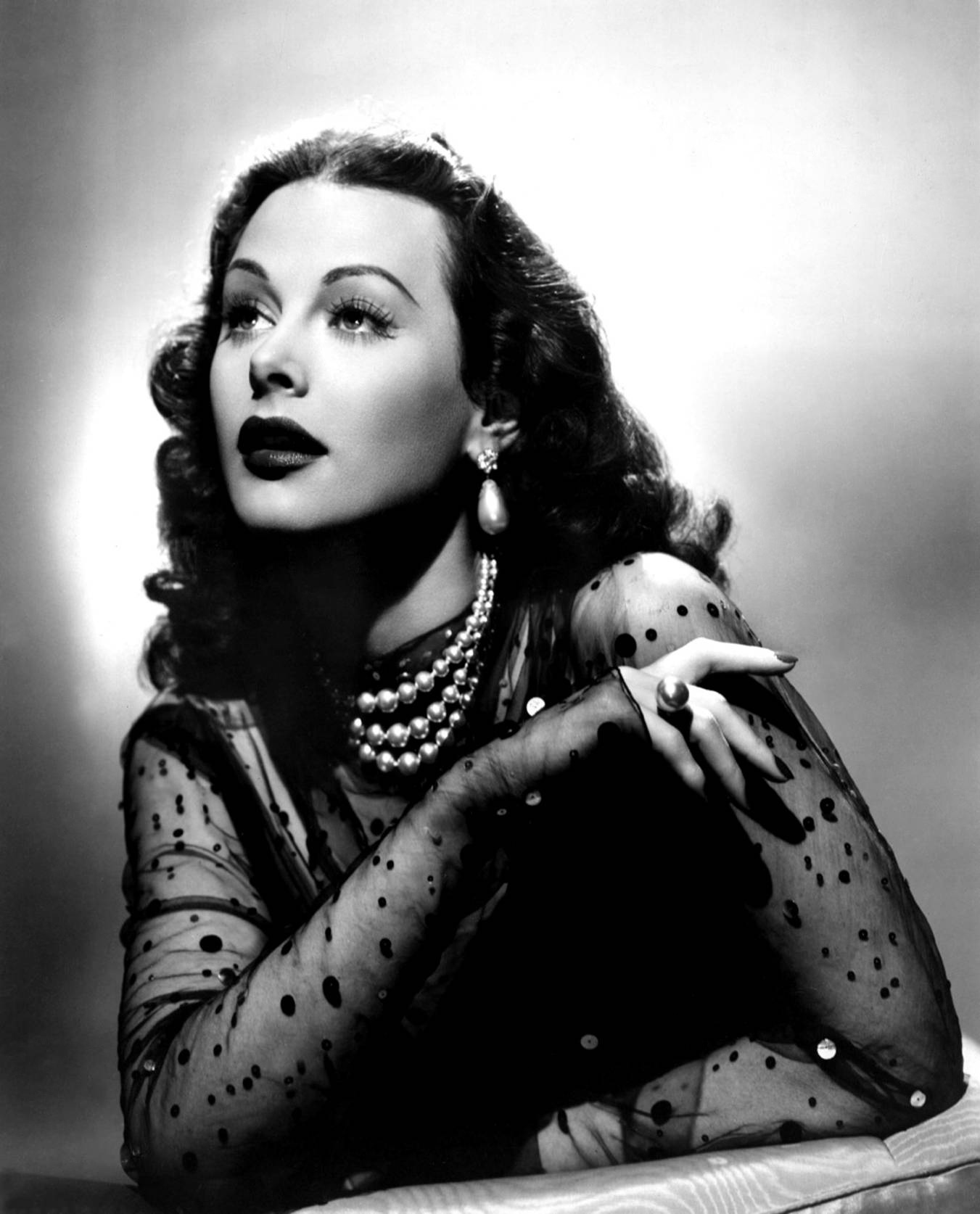
So, what do you think? Is Lamarr an appropriate "fashionable feminist icon"? Can women be stereotypically beautiful, specifically enhance and use that beauty in stereotypical ways, and still do work that leads to feminist goals? (I personally love that her job description is listed on sites as "actress/inventor"!) Why are we (or at least I) still occasionally surprised to find that a great beauty also has a great mind?
UPDATED: Other Fashionable Feminist Icon posts!
Björk - Oranges and Apples
Christine Lagarde– Rags Against the Machine
Cindy Sherman - Mrs Bossa Does the Do
Claude Cahun - Cervixosaurus
Diane Von Furstenberg – For Those About to Shop
Elizabeth Smith Miller – Techie Style
Ellen Page – SK{ru}SH
Frida Kahlo - La Historiadora de Moda from Fashionable Academics
Frida Kahlo – Knitting Up the Ravelled Sleeve of Care
Gloria Steinem – Ef for Effort
Gloria Steinem - What If No-One’s Watching?
Gloria Trevi - Feministified
Grandmother – The House in the Clouds
Griselda Pollock - Magic Square Foundation
Marjane Satrapi - Jean of all Trades
Joan of Arc – Interrobangs Anonymous
Julia de Burgos – Mad Dress Game
Margaret Cho – What Are Years?
Oroma Elewa - Fishmonkey
Rachel Carson – Aly en France
Siouxsie Sioux - Yo Ladies
Sydney Fox - My Illustrative Life
Vivienne Westwood - Seamstress Stories
When I started figuring out who I wanted to write about, I was a bit stumped. I realized that I don't have many true "icons" either in fashion or in feminism...so I chose to write about a woman who demonstrates a "feminist" trait I find particularly interesting, the ability to contribute to traditionally male-dominated fields. However, this woman also retained traditional "feminine" dress and activities, and was known for her beauty. As a woman who is a scientist/researcher/artist/student, I am especially interested in examples where technical ability and more traditional performance of femininity coexist in the same person. I don't think that one is necessarily more or less of a feminist for working in male-dominated jobs or female-dominated jobs, for striving for stereotypical beauty ideals or by actively avoiding them. So, I'm writing today about Hedy Lamarr, a major movie star in the 1930's and 1940's, as well as one of the inventors of spread spectrum wireless technology. I first heard about Lamarr in a class I took a couple of years ago on signal processing, and thought her story was fascinating.
Lamarr was born in Austria as Hedwig Kiesler, first made famous through German and Czech films, and then through her film work in America after she moved to Hollywood in the late 1930's. (She left her first husband, the Austrian Fritz Mandel, as his Nazi sympathies grew, escaping first to London and then to America.) She was particularly known for her good looks: Max Reinhart called her "the most beautiful woman in Europe." George Sanders, who costarred in several movies with Lamarr, said of her, "When I first met Hedy Lamarr, about twenty years ago, she was so beautiful that everybody would stop talking when she came into a room. Wherever she went she was the cynosure of all eyes. I don't think anyone concerned himself very much about whether or not there was anything behind her beauty, he was too busy gaping at her. Of her conversation I can remember nothing: when she spoke one did not listen, one just watched her mouth moving and marveled at the exquisite shapes made by her lips. She was, in consequence, rather frequently misunderstood."
So, what's less well known about Lamarr that she was also a mathematician, inventor, and scientist. In particular, she developed of an early form of spread spectrum technology with the composer George Antheil. In Hollywood, Lamarr met Antheil, best known now for his Ballet Mechanique, a composition for dozens of mechanical instruments including 16 player pianos, electric bells and sirens, and airplane propellers. It was World War II, and Lamarr had been thinking of quitting her job at MGM and going to work for the government developing new wartime technologies, like radio control for torpedoes. While she was married to Mandel, she had learned a lot about military technologies, including the ease with which a radio control signal on a single frequency could be intercepted or jammed. Lamarr determined that splitting a signal into many sections and jumping between different frequencies for each section would create a signal that a jammer could not significantly harm; the difficulty would be in synchronizing the sequence of frequencies between the sender and the receiver. Antheil thought that this could be done mechanically, using a player-piano-like roll in each part with timed markings signaling the change to a different frequency. Their patent for this "frequency hopping" system was approved in 1942.
An image from the patent:
The government was skeptical of their system (perhaps especially because of Antheil's comparison to a player piano...so they were supposed to put mini player pianos inside their torpedoes?) Eventually, Lamarr and Antheil's patent expired, without their idea having taken off. However, the military did end up using similar concepts (though implemented electronically, rather than mechanically) during the Cuban Missile Crisis. Now, the "frequency hopping" idea, called Spread Spectrum technology, is used in data transmission, wireless phones, and the government's Milstar defense communication system. Lamarr was finally recognized with the Electric Frontier Foundation Pioneer Award for technological innovation in March 1997.
Lamarr never did quit her job at MGM to go work for the military: it was determined that she would be of better service raising money for war bonds as a movie star. (In fact, at one event, she raised $7,000,000!) Lamarr's later life was also complicated, with shoplifting scandals and a total of six husbands. So, perhaps she's not much of a classical feminist. But she did push past the boundaries set on her due to her beauty, and people's tendencies to only look at her exterior, to make some valuable contributions with her technical abilities in a field that at the time (even more so then than now) was dominated by men.

Lamarr also said some interesting things (and some fairly complicated ones, in terms of feminist ideals):
On her own appearance:"My mother always called me an ugly weed, so I never was aware of anything until I was older. Plain girls should have someone telling them they are beautiful. Sometimes this works miracles."
On relationships: "Perhaps my problem in marriage - and it is the problem of many women - was to want both intimacy and independence. It is a difficult line to walk, yet both are important in a marriage"
"I must quit marrying men who feel inferior to me. Somewhere there must be a man who could be my husband and not feel inferior."
On fashion: "I think women are concerned too much with their clothes. Men don't really care that much about women's clothes. If they like a girl, chances are they'll like her clothes."
"Any girl can be glamorous. All you have to do is stand still and look stupid."
On using one's sexuality for success: "The ladder of success in Hollywood is usually a press agent, actor, director, producer, leading man; and you are a star if you sleep with each of them in that order. Crude, but true."
"If you use your imagination, you can look at any actress and see her nude ... I hope to make you use your imagination."
For more information on Hedy Lamarr, I found some nice pieces on inventions.org, madehow.com, and the official Hedy Lamarr website..
So, what do you think? Is Lamarr an appropriate "fashionable feminist icon"? Can women be stereotypically beautiful, specifically enhance and use that beauty in stereotypical ways, and still do work that leads to feminist goals? (I personally love that her job description is listed on sites as "actress/inventor"!) Why are we (or at least I) still occasionally surprised to find that a great beauty also has a great mind?
UPDATED: Other Fashionable Feminist Icon posts!
Björk - Oranges and Apples
Christine Lagarde– Rags Against the Machine
Cindy Sherman - Mrs Bossa Does the Do
Claude Cahun - Cervixosaurus
Diane Von Furstenberg – For Those About to Shop
Elizabeth Smith Miller – Techie Style
Ellen Page – SK{ru}SH
Frida Kahlo - La Historiadora de Moda from Fashionable Academics
Frida Kahlo – Knitting Up the Ravelled Sleeve of Care
Gloria Steinem – Ef for Effort
Gloria Steinem - What If No-One’s Watching?
Gloria Trevi - Feministified
Grandmother – The House in the Clouds
Griselda Pollock - Magic Square Foundation
Marjane Satrapi - Jean of all Trades
Joan of Arc – Interrobangs Anonymous
Julia de Burgos – Mad Dress Game
Margaret Cho – What Are Years?
Oroma Elewa - Fishmonkey
Rachel Carson – Aly en France
Siouxsie Sioux - Yo Ladies
Sydney Fox - My Illustrative Life
Vivienne Westwood - Seamstress Stories
Tuesday, February 15, 2011
On Fashion and Feminism

Today, I mostly want to talk about a topic that I've been thinking about for a while in relationship to my personal style. Recently, I've come across a number of very interesting items around the fashion/style blogosphere discussing the intersection of fashion and feminism...something that's been quite close to my heart as a female, somewhat fashion-conscious student and researcher in a male-dominated technological field. In fact, the Fashionable Academics have a very interesting "call for papers" going on right now, asking for people who consider themselves feminists to submit brief descriptions of what feminism means to them. (If this sounds interesting to you, the deadline isn't till this Friday!). So I sent in my piece:
I am a female computer scientist: to me, feminism means pushing for a world where the description of myself as "female" does not affect others' perception of my skill as a "computer scientist." To me, feminism means equality of pay and equality of opportunity for men and women, without labeling either men or women as inherently, stereotypically, "better" at particular things. I believe we can recognize and be comfortable with differences (both societal and biological) between the genders while primarily supporting and honoring the unique abilities of each person regardless of their gender. If a person performs behaviors currently associated more with men or with women (or anywhere in between), I believe that performance should not reflect on that person's overall capabilities or their relationship to feminism. I am not more of a feminist when I wear a little mascara, or red lipstick, or no makeup at all. I am not more of a feminist when I wear sneakers or stilettos or boots. I am not more of a feminist when I study costume design or computer science or physics or cooking. In my ideal world, one's behaviors and ways of presenting oneself to the world are primarily expressions of self rather than expressions of a fixed or stereotyped gender.
On a related note, it's interesting for me to realize how much more comfortable I've gotten in the last year or so with wearing "stylish," "feminine" clothing. As I got more interested in computer science during college, I was aware that I focused on my clothing choices in the context of my field. Studies showed that girls do worse on math than boys only when they are made to think beforehand about their gender (and thus, it is suspected, remember the societal stereotypes about girls being bad at math). So, to fight this effect, I would make sure on test days never to wear skirts or dangling earrings or any clothing that was obviously coded as "female." Looking back, I find this effort a little bit silly...or at least troubling that I felt I had to make that effort.
Now, I'm almost doing the opposite thing. I take pleasure in wearing clothing that is coded as female while being quite competent in technical areas. Soldering in heels? Yes please! But at times this is a performance of gender as well; in my own subtle way, I'm attempting to subvert the expected relationship between femininity and technical ability. I'm particularly careful to wear a dress if I know I'll be demoing things to schoolchildren, to try to telegraph to the girls (and boys) that there isn't a discrepancy between being "girly" and doing computer science work. I'm certainly often performing femininity with my clothing (in a way that I think is consistent with my own desires for sartorial self-expression, even though I probably would revert to jeans and a fitted tee if I knew I wasn't going to see anyone that day.) But even with my recent efforts, I'm still careful not to seem too interested in fashion. I definitely try to make sure my blog doesn't show up on search results for me and my professional work. I'd love to see a time when I wouldn't have to worry about how some of my interests (especially the more female-coded ones like style, crafting, and sewing) would negatively affect the perception of my work-related capabilities.
Anyway. I'd love to hear what others think about some of these issues! If you're interested and want to read a couple of the posts that started me thinking and writing about this, check out Franca's thought-provoking post, and Those Grace's decision to become a feminist beauty blogger.

Quickly, about my Valentine's Day outfit from yesterday...didn't do much besides go to work, as the boyfriend and I decided to go out tonight instead (had a great deal for a fancy dinner on Tuesday or Wednesday nights). I still wanted to be somewhat holiday-appropriate, which led to the red dress that I had finally finished hemming over the weekend (it used to be floor-length with long sleeves. Far too much red plaid for me.) The overall ensemble ended up being referred to as "Gothic Lolita" by a coworker...not sure what I think about that!
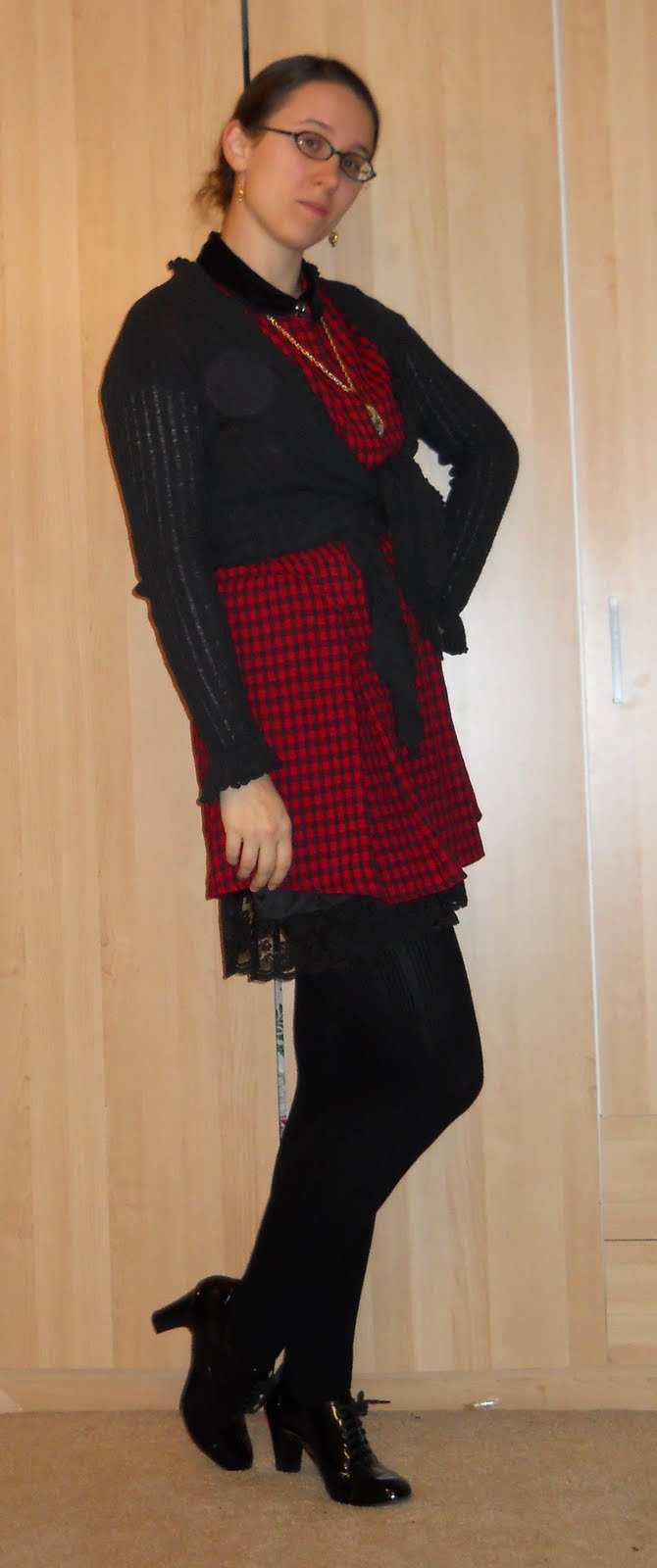
Details: Dress, thrifted and DIY'd. Lace-trimmed slip, thrifted. Shoes, Nine West. Sweater, Express. Necklace, estate sale. Earrings, handmade. Belt, from a thrifted dress. Tights, Loft.
Hope everyone is having a good week!
Subscribe to:
Posts (Atom)
